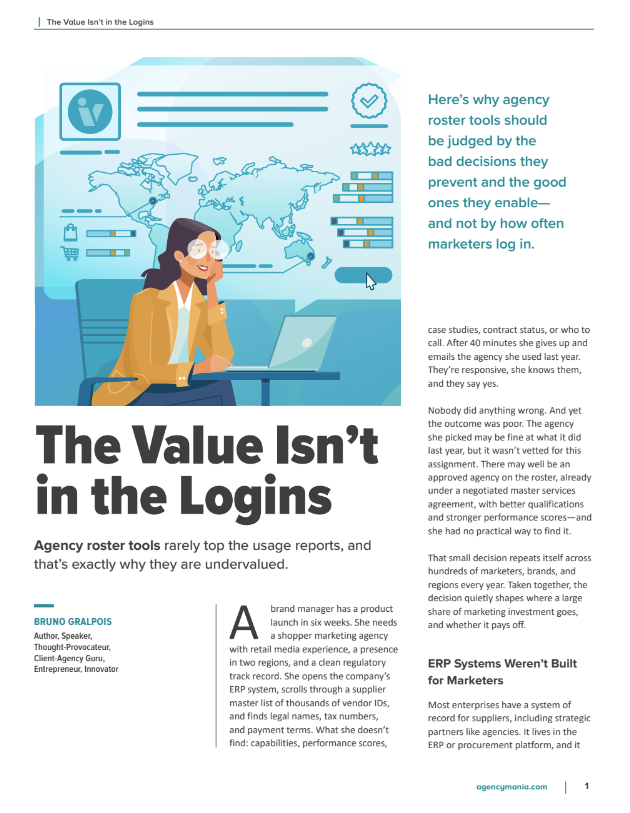
Agency roster tools rarely top the usage reports, and that’s exactly why they are undervalued.
Here’s why those tools should be judged by the bad decisions they prevent and the good ones they enable—and not by how often marketers log in.
A brand manager has a product launch in six weeks. She needs a shopper marketing agency with retail media experience, a presence in two regions, and a clean regulatory track record. She opens the company’s ERP system, scrolls through a supplier master list of thousands of vendor IDs, and finds legal names, tax numbers, and payment terms. What she doesn’t find: capabilities, performance scores, case studies, contract status, or who to call. After 40 minutes she gives up and emails the agency she used last year. They’re responsive, she knows them, and they say yes.
Nobody did anything wrong. And yet the outcome was poor. The agency she picked may be fine at what it did last year, but it wasn’t vetted for this assignment. There may well be an approved agency on the roster, already under a negotiated master services agreement, with better qualifications and stronger performance scores—and she had no practical way to find it.
That small decision repeats itself across hundreds of marketers, brands, and regions every year. Taken together, the decision quietly shapes where a large share of marketing investment goes, and whether it pays off.
ERP Systems Weren’t Built for Marketers
Most enterprises have a system of record for suppliers, including strategic partners like agencies. It lives in the ERP or procurement platform, and it does its job well: vendor onboarding, purchase orders, invoicing, payment. It was never designed, however, to help a marketer decide which agency is right for a given project. The data is transactional, not qualitative. The interface is built for Finance and Procurement users. And the information marketers need most—approved capabilities, line of business, geographic coverage, specialty, diversity status, performance ratings, key contacts, work examples—is usually missing or out of date.
So marketers do what busy people do. They ask a colleague, search their inbox, or default to an agency they already know. Past research from the McKinsey Global Institute* has long estimated that knowledge workers spend nearly a fifth of their workweek searching for and gathering internal information. Even with the advance of AI, finding a name quickly doesn’t mean finding the right partner. In marketing, where launch windows don’t move and a missed week can cost a season, that lost time is expensive in its own right. The bigger cost is the decision it leads to.
Familiar Isn’t the Same as Qualified
Going back to the same agency because it’s easy is one of the most common, and least discussed, habits in marketing. It feels efficient. It feels low risk. The relationship is comfortable. They know you by name. But convenience is a poor way to choose an agency. The agency a marketer happens to know best is often not the one best suited to the brief, whether that means the right category experience, channel expertise, regional footprint, or track record against the KPIs that matter for the campaign.
When an organization makes it hard to find the approved and qualified option, it effectively rewards the familiar one. You don’t know what you don’t know and that’s as dangerous as it gets. And when the familiar option isn’t on the approved roster at all, the problem becomes much bigger than performance.
The Roster Paradox: Low Traffic, High Value
A roster is where marketing operations, marketing procurement, and agency relation leaders run into trouble. Most agency management tools are used on a predictable schedule. Performance evaluations run annually or semiannually. Scope of work and fee planning follow the budget cycle. Compensation reconciliation runs monthly, quarterly, or at year-end. The tools have built-in rhythms, so usage is steady and easy to report.
A roster tool doesn’t work that way. It gets used when someone needs it: a new project, a new brand manager, a reorganization, an urgent request. Usage is irregular by nature, and a given marketer may only search the roster a few times a year. On a dashboard, that can look like weak adoption. When Procurement or agency management has to justify the initial investment, or the renewal, against tools with higher and steadier usage, the roster tool often loses that comparison.
That’s the wrong comparison to make. Nobody judges a fire extinguisher by how often it’s used. A roster tool’s value is concentrated in a relatively small number of high-stakes moments, and each of those moments can be worth far more than the annual cost of the tool itself.
Where the Value Actually Comes From
Risk is mitigated. A marketer who hires an agency outside the approved roster—with no MSA, no negotiated terms, no data privacy or confidentiality provisions, no insurance requirements, and no IP ownership clauses—exposes the company to real legal and financial liability. In regulated industries like pharma, using an unvetted agency on promotional or patient-facing material can create compliance exposure far more costly than any media budget. A single avoided incident can pay for the tool many times over, sometimes by millions of dollars.
Business outcomes improve. Matching a project with the most qualified agency, rather than the most familiar one, directly affects campaign performance. If the right agency improves a launch’s results even modestly, the incremental revenue usually dwarfs the investment.
Negotiated rates actually get used. Approved roster agencies operate under contracts Procurement has already negotiated: rate cards, payment terms, volume discounts. Work that goes to off-roster agencies at ad hoc rates erodes those savings and fragments spend that could otherwise strengthen leverage at the next negotiation.
Less internal time is wasted. Every hour a marketer spends hunting for agency information, asking around, or re-collecting credentials that already exist somewhere is an hour not spent on the work itself. Multiply that across a marketing organization, and the hidden cost adds up quickly.
Projects get to market faster and better. When the right agency can be found in minutes, with current contacts and contract status, projects start sooner. In marketing, speed is often a competitive advantage in itself. Do not trade better for fast either. Everyone internally should know which agencies perform the best most consistently. A high-performance agency hired expediently is what brands want.
Reputation is protected. Qualified, vetted agencies are less likely to produce work that creates brand safety, compliance, or ethical concerns. Roster tools that capture diversity status and supplier certifications also help companies meet their supplier diversity commitments with real data.
There is a single, trusted source of truth. A well-maintained roster, kept current by the agencies themselves through automated update reminders, gives leadership a clear view of who the company works with, for what, and how well. Things change rapidly in the agency world. That visibility supports consolidation decisions, roster reviews, and strategic planning.
The Measurement Problem
All of this is real. Much of it is also anecdotal. Nobody sends a memo saying, “We avoided a multimillion-dollar dispute because the brand manager found the approved agency instead of hiring a friend’s shop.” The campaign that outperformed because it went to the right specialist doesn’t come labeled with the reason. The value of a roster tool shows up in events that didn’t happen and in decisions that went well for reasons nobody wrote down.
That is why brand advertisers so often struggle to defend roster investments—and why the business case has to be built on purpose rather than left to usage statistics.
What Brands Should Do, Starting Now
There are ways for brands to capture, and prove, the full value of a roster tool:
1. Stop using usage as the main measure of value. Set expectations with leadership, Finance, and Procurement early: a roster tool is used as needed, not on a schedule. Login counts and session frequency measure activity, not value. Agree on that before the first renewal conversation.
2. Estimate value in business terms. Build a simple value model around the outcomes that matter: cost avoided through negotiated rates, time saved per search multiplied across users, legal and compliance risk avoided, and performance gained from better agency-to-project matching. Directionally right estimates beat precisely measured irrelevant metrics.
3. Let marketers open a PO from the roster tool. This is perhaps the most effective way to make the roster the source of truth. If raising a purchase order starts with selecting an approved agency in the roster tool, integrated with the ERP behind the scenes, the approved path becomes the easiest path. Marketers stop seeing the tool as an extra step, and Procurement gets compliance by design rather than by policing.
4. Make it the single source of truth across the enterprise. One agency roster management system, filterable by company, region, division, brand, and capability, is far more useful than a patchwork of spreadsheets kept by each business unit. Secure executive endorsement for a simple rule: if an agency isn’t in the roster, it isn’t approved.
5. Keep the data current and let agencies do the work. An outdated roster is barely better than none. Require roster agencies to maintain their own profiles—capabilities, case studies, key contacts, certifications—with automated reminders and an administrator approval queue to keep quality high.
6. Connect performance data. A roster that shows approved agencies is useful. A roster that also shows how each agency performs, through integrated evaluation scores, helps marketers make better decisions and rewards top performers with more work.
7. Track off-roster spend as a leading indicator. Monitor how much spend goes to non-approved agencies over time. A declining trend is one of the clearest quantitative signals that the roster tool is doing its job, even when usage looks modest.
8. Collect stories. Ask marketers and agency managers to report specific instances when the roster made a difference: a faster start, a better match, a near-miss with an unapproved vendor. Over time, those cases become the evidence that turns an anecdotal benefit into a defensible business case.
Value the Decisions, Not the Logins
The best agency decisions are rarely the most convenient ones. They come from marketers who can quickly see every approved, qualified option and choose the best fit for the work. A roster tool exists to make that the easy choice.
Usage is not value. Convenience is not qualification. The brands that understand the difference will spend less time searching, take on less risk, and put the right agency on the right work far more often. A roster tool deserves to be valued for the decisions it improves, not for how often people log in.
Download the Article
Request a Demo
Source: McKinsey Global Institute, “The Social Economy: Unlocking Value and Productivity Through Social Technologies,” July 2012.
Our clients’ ongoing accomplishments result from cutting-edge practices in the area of client–agency performance evaluations. See how stronger relationships contribute to better marketing.
To drive greater value from your client–agency relationships, check out industry reference Agency Mania.
And sign up for our complimentary, bimonthly Industry Update.
Author, Speaker, Thought Provocateur, Client-Agency Guru, Entrepreneur, Innovator
Bruno Gralpois is the co-founder of Agency Mania Solutions, a premier service and technology firm specialized in helping companies realize the transformational value of managed partnerships. Bruno is the author of bestseller Agency Mania and the former chair of the Association of National Advertisers Client/Agency Committee and a faculty member of the ANA School of Marketing.