Some agency relationships look strong but are quietly failing. Others look broken but are one honest conversation away from their best work. Bruno Gralpois explains how a structured, reciprocal agency relationship assessment tells the difference, and why new WFA research says clients hold more of the answer than most would care to admit.
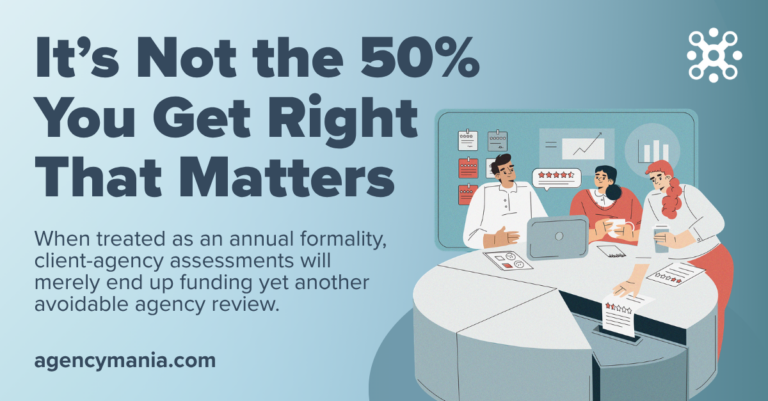
In a recent article I made the case that agencies aren’t lost over the 50% of the relationship you get right. They’re lost over the 50% you never got around to fixing. The article’s response from clients and agencies alike told us we touched a nerve. It also raised a harder question: what happens when the assessment itself is reading the wrong signals? Here’s the thing about client-agency relationships: unless done properly, they are remarkably good at fooling us. In both directions.
The Illusion of Strength
Every agency roster has one. The relationship nobody worries about. Meetings are cordial. Deadlines are mostly met. The annual scorecard comes back comfortably above midpoint. Nobody is escalating anything.
Look closer, and the symptoms are hiding in plain sight:
The relationship seems healthy, but it’s not.
Satisfaction scores are stable, but stability is not the same as strength. What looks like alignment is often just the absence of conflict—and those are two very different things.
The work happens, but it’s difficult.
Projects ship, but every one of them feels like pushing a boulder uphill. Too many rounds of revisions. Too much unproductive back-and-forth. Too many escalations to “get it over the line.” The path to the output is exhausting.
People get along, but the quality is suboptimal.
Teams like each other. They have great chemistry. And the work is… just fine. Competent. Safe. Plain. Rarely breakthrough. Warmth on the “relationship” attributes masks a quiet decline on the “work” attributes, and the averages blend the two into something that looks reassuring. It shouldn’t be.
It takes too much energy to get there.
You feel that you have to do too much of the agency’s thinking. You’re rewriting or redirecting the strategy, basically hand-holding the work through completion. Good work does happen occasionally, but only because the client invested far more effort than they should have. That is not a partnership. It is a subsidy, and clients are paying twice for that work.
The agency is reactive, not proactive.
The agency answers every brief and fulfills every request. It rarely, however, brings an unsolicited idea, challenges a weak brief, or anticipates the next problem. It has become an order-taker in a relationship that was supposed to deliver a strategic partner. And you want more.
Poor client practices are accepted.
Vague scopes or briefs, shifting timelines, too many approvers, conflicting feedback, work starting before a PO is issued—the agency has stopped pushing back. Not because the problems went away, but because flagging them felt risky. Silence is not satisfaction. It is fatigue. You both deserve better.
Any one of these on its own is manageable. Barely. Together, they describe a relationship running on goodwill and inertia. It will look deceptively sudden when the relationship runs out of both. The most dangerous relationships on a roster are rarely the ones in open conflict. They are the comfortable ones, in which politeness has quietly replaced performance, and nobody wants to be the first to say so.
The Reverse Illusion: Broken, but Not Beyond Repair
Now flip the picture. Some relationships look as if they are falling apart over disagreements about strategic or creative direction. Both parties care deeply. So why have relationship assessment scores dropped? Frustration is loud on both sides. A senior client stakeholder has started asking confidentially whether it’s time for a review. The agency seems defensive; the client team is under pressure to deliver. Yet often this relationship is far closer to great work than the comfortable one described above.
Why? Because the friction is visible, and visible friction can be diagnosed. When we dig into these “broken” relationships through structured, reciprocal assessments, the root causes are frequently not what anyone assumed. The agency isn’t lacking talent or commitment. It’s working from briefs that are weak in substance and change midstream. It’s waiting on approvals from too many stakeholders and receiving vague or contradictory feedback. It’s being asked to deliver against expectations that were never clearly articulated or within budgets that were too tight.
In other words, a large share of what gets labeled “agency underperformance” is, at its core, a client-side practice problem. And client-side practice problems are the cheapest, fastest problems in the relationship to fix—certainly cheaper than a multi-month agency review and transition.
Consider a familiar scenario. A brand’s lead creative agency scores below target two cycles in a row, and the CMO is ready to call a review. Before anyone does, the brand runs a reciprocal assessment. The agency’s feedback is consistent: briefs are weak in substance, too many approvers weigh in on every round, and budgets are confirmed weeks after work begins. The brand fixes three things: a single brief template, fewer approvers, and budget sign-off before briefing. Two cycles later, scores are back above target. Nothing about the agency changed. The client did.
What the Research Tells Us
In September 2026, Agency Mania Solutions partnered with the World Federation of Advertisers (WFA) on a global study, “How Brands Define, Scope and Reward Agency Work,”* which surveyed top multinational companies. When we asked brands what helps agencies produce performing work, the answer could not have been clearer: great briefing (5.6 out of 6), respect and trust (5.2), high-quality feedback (5.1), clarity of roles across brand and agency teams (5.1), and close working relationships (4.9).
Look closely at that list. Nearly every one of those top drivers sits largely in the client’s hands. The client writes the brief. The client sets the tone for trust. The client gives, or fails to give, quality feedback. The client defines roles and decision rights. The implication is profound: the single biggest lever on agency performance isn’t the agency, and, more often than not, it isn’t the fee. It is the client’s own behavior—and the client’s willingness to hear feedback about that behavior and act on it.
Yet we don’t consistently act like we know this. Only 25% of brands say their standardized briefing framework is used consistently, a figure that’s just 13% in creative and production. And 38% of brands say agency relationship management has become more difficult over the past year. Relationships are getting more complex. Expectations are higher than ever.
The temptation is to blame the partner. The opportunity is to look in the mirror.
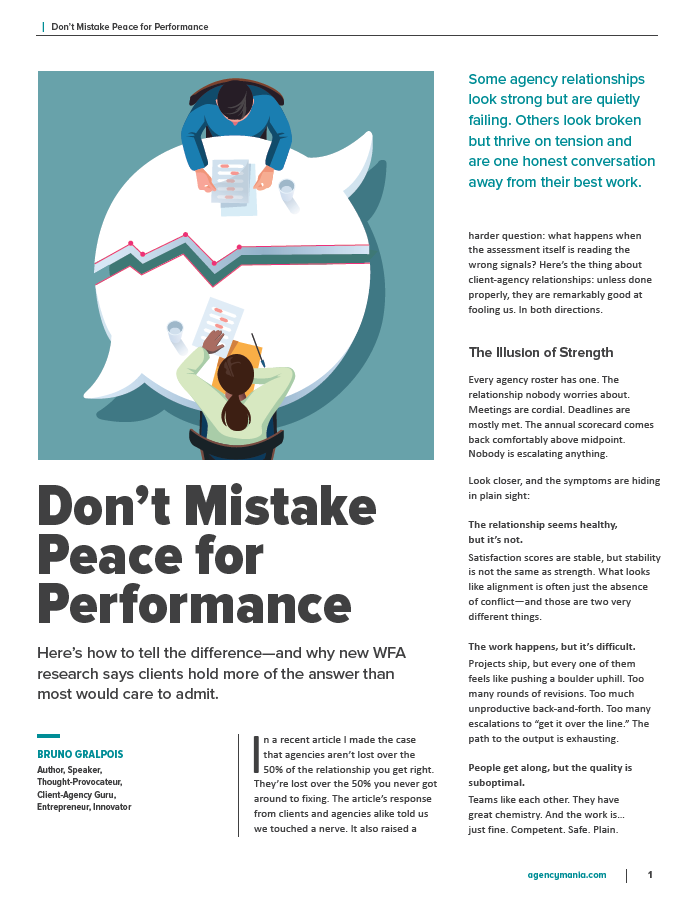
That is precisely why feedback matters so much. Not the once-a-year, check-the-box variety, but structured, two-way feedback that also asks agencies how easy you are to work with—and then does something about the answer. Brands that do this consistently don’t just improve their scores. They change the trajectory of the relationship, often within a single evaluation cycle.
How to Tell the Difference
So how do you know whether you’re looking at an illusion of strength or a relationship that only appears broken? A few diagnostic questions help:
Is there a gap between “relationship” scores and “work” scores?
High marks on chemistry and responsiveness paired with flat or declining marks on strategic thinking, proactivity, and creative quality are a classic warning sign of comfort masquerading as health.
What does the agency say about you?
If you’re not running a reciprocal assessment, you’re only seeing half the picture. A relationship in which the agency rates the client poorly on briefing, feedback, and decision-making is telling you exactly where to start.
How much effort does good work require?
Ask your teams not just about outcomes but also about the energy it took to get there. Exhaustion is data.
Which way is the trend moving?
A single score tells you little. A trend across midyear and annual cycles, and across project-level or pulse evaluations, tells you whether the relationship is improving, plateauing, or eroding.
Who is bringing ideas to the table?
If every new idea originates on the client side, the agency has stopped leading—or has been taught not to.
Look Past the Surface
Years of experience conducting this type of agency relationship assessment taught us at Agency Mania Solutions a valuable lesson: the relationships we celebrate aren’t always the ones that deserve it, and the ones we’re ready to walk away from are often the most worth saving. The difference rarely shows up on the surface. It shows up when brands are willing to ask harder questions, listen to the answers, and act on them.
My recent article argued that agencies are lost over the 50% you never got around to fixing. This one adds a caveat: first, make sure you know which 50% that is. Peace is not performance. Friction is not failure either. The brands that learn to tell the difference will spend less time replacing agencies and more time getting the best from them. And great work is what great brands need.
What Brands Should Do, Starting Now
Brand advertisers can get better work by pushing, challenging, hustling, and partnering more effectively:
- Stop treating the absence of complaints as proof of health. Silence often means fatigue, not satisfaction. Probe your “comfortable” relationships with the same rigor you apply to the troubled ones.
- Separate the relationship from the work. Report relationship attributes and work-quality attributes separately and independently. Never let good chemistry average away mediocre output.
- Make every assessment reciprocal. Ask agencies to rate you on briefing, feedback, timelines, approvals, and decision-making. Compare it against your own self-assessment. The gaps are your action plan.
- Measure effort, not just outcomes. Add questions that capture how hard it was to get to good work because of things like rounds of revision, escalations, and rework. A relationship that delivers only when the client overcompensates is not performing.
- Reward proactivity explicitly. Tell your agencies you expect them to challenge briefs, bring unsolicited ideas, and flag problems early. When they do, make sure your organization doesn’t punish them. To the contrary.
- Fix your own practices first. Before anyone utters “review,” audit what’s within your control: brief quality, budget sign-off before briefing, number of approvers, feedback clarity, and POs issued before work begins.
- Close the loop, every time. Turn every material finding into an action plan with a named owner and a date, on both sides of the table. Open the next assessment by reporting progress. Feedback without action is just noise; feedback with action is how relationships get rebuilt.
*Source: WFA–Agency Mania Solutions research, “How Brands Define, Scope and Reward Agency Work,” September 2026. Online survey conducted in May 2026 of 69 multinational companies across six industry sectors, compared with similar studies in 2011, 2014, 2018, and 2022.
Our clients’ ongoing accomplishments result from cutting-edge practices in the area of client–agency performance evaluations. See how stronger relationships contribute to better marketing.
To drive greater value from your client–agency relationships, check out industry reference Agency Mania.
And sign up for our complimentary, bimonthly Industry Update.
Author, Speaker, Thought Provocateur, Client-Agency Guru, Entrepreneur, Innovator
Bruno Gralpois is the co-founder of Agency Mania Solutions, a premier service and technology firm specialized in helping companies realize the transformational value of managed partnerships. Bruno is the author of bestseller Agency Mania and the former chair of the Association of National Advertisers Client/Agency Committee and a faculty member of the ANA School of Marketing.